Your life-long savings account
The TFSA (tax free savings account) is an account created by the Canadian federal government that allows you to save without paying taxes on gained interests. It is a key financial tool where your savings can grow tax-free.
You can use your TFSA for multiple goals:
- The down payment on a house
- A trip or personal project
- An emergency or financial security fund
Unlike other accounts, everything you earn in your TFSA — interest, dividends or capital gains — is 100% tax-free, even when you withdraw it.
TFSA (Tax-Free Savings Account)
TFSA BENEFITS
Tax-free growth on your returns
Total flexibility: withdraw your money anytime
Ideal for short-, medium- and long-term goals
Does not affect your government benefits (credits or subsidies)
You can accumulate the rights of unused contribution room
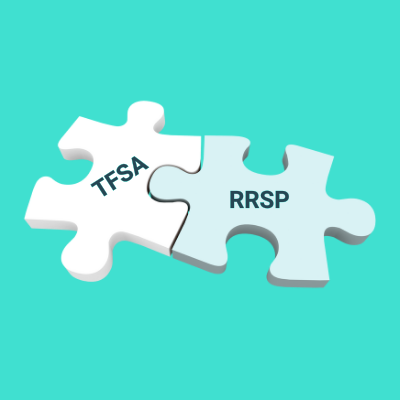
Compatible with a TFSA + RRSP combined strategy
Combined TFSA + RRSP strategy
- Contribute to your RRSP as much as you can.
- If you receive a tax refund that year, invest it in your TFSA to make it grow tax-free.
- RRSP contributions are made at the beginning of the year while TFSA contributions are made at the end.
This cycle creates a smart financial flow that helps you build wealth year after year.
TFSA FREQUENTLY ASKED QUESTIONS
How much can I contribute to my TFSA?
The annual contribution limit varies according to current legislation. You can contribute up to the maximum allowed and recover your contribution room when you make withdrawals.
What do I need to open a TFSA?
• Be a Canadian resident.
• Be 18 years old or older.
• Have a valid Social Insurance Number (SIN).
What happens if I withdraw money from my TFSA?
You can withdraw at any time without paying taxes. The withdrawn amount will be added back to your contribution room in the next calendar year.
Can I have more than one TFSA?
Yes, you can have multiple TFSAs in different institutions, but your total contributions must stay within your annual limit.
What’s the difference between a TFSA and an RRSP?
A TFSA allows you to save and withdraw both contributions and investment gains tax-free. An RRSP gives you an immediate tax deduction, but withdrawals are taxed as income. In short: TFSA is ideal for short/mid-term goals; RRSP is focused on long-term retirement saving.
What’s the difference between a TFSA and an FHSA?
The FHSA (first-home savings account) is designed specifically for saving for your first home purchase. Both allow tax-free growth, but the FHSA has contribution and time limits. The TFSA is more flexible and can be used for any financial objective. If one of your goals is to purchase your first home, you can combine the TFSA with a FHSA to maximize growth on your savings efforts.
START BUILDING YOUR FINANCIAL SECURITY TODAY!
Make your money work for you with a tax-free strategy
let a professional guide you
Confianza construida con resultados
Más de 10 años ayudando a personas en Quebec y Montreal a crecer su patrimonio con estrategias seguras y sostenibles
Publié sur Google Olga Canelas29/10/2025Trustindex vérifie que la source originale de l'avis est Google.
Adipiscing elit, sed do eiusmod tempor incididunt ut labore et dolore magna aliqua ut enim ad minim. of high value and temperature sensitive loads monitored times.
Co Founder
Jhon william
Adipiscing elit, sed do eiusmod tempor incididunt ut labore et dolore magna aliqua ut enim ad minim. of high value and temperature sensitive loads monitored times.
Co Founder
Sarah albert
Adipiscing elit, sed do eiusmod tempor incididunt ut labore et dolore magna aliqua ut enim ad minim. of high value and temperature sensitive loads monitored times.
Co Founder
Mike hardson
Learn more about the tax advantages of Canadian registered accounts
Tips to make the most out of your TFSA
- Financial security
- The 3 mistakes that keep you from achieving financial stability (and how to avoid them)
- Saving and investing
- TFSA, RRSP or FHSA: Choose the best account to grow your money in Canada
- Financial security
- Life, Disability or Critical Illness Insurance: Which One Do You Really Need?