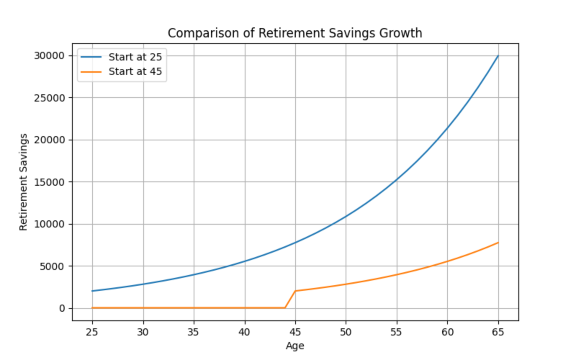
There are two phases in the RRSP life time: the accumulation phase and the withdrawal phase.
Accumulation phase
Dynamic growth with a constant savings habit that profit from compund interest
Contribute early and regularly:
The earlier you start and the more you persevere, the more compound interest works for you.
Invest strategically:
Choose your investments based on your risk profile and goals.
Save on taxes:
Your contributions reduce your taxes and you can reinvest tax refunds.
Financial tip:
Talk to your accountant at the beginning of the year to know your RRSP contribution room. Do not let this conversation for the last minute, you might miss the deadline to make contributions.
Talk to a security financial advisor to better understand the two RRSP phases considering your current life situation.
Withdrawal phase
Using your savings as income in your retirement
Plan your retirement
Consider longevity, the age you would like to stop working and the lifestyle you wish to have at this stage.
Withdraw strategically
Think about making small withdrawals and the tax impact they will have on your income tax.
Complement your income
Your RRSP works alongside government programs and employer pensions.
What is the difference between an RRSP and a TFSA?
RRSP contributions reduce your taxes now, but withdrawals are taxed later. TFSA contributions don’t reduce taxes today, but withdrawals are 100% tax-free.
How much can I contribute each year?
Up to 18% of your previous year’s earned income, capped by the government (e.g., $33,810 CAD in 2026). Unused contribution room carries forward.
What happens if I withdraw before retirement?
Withdrawals are taxable, except under special programs like the HBP or LLP (Lifelong Learning Plan).
Can self-employed workers open an RRSP?
Yes, RRSPs are available for self-employed individuals as well.
What do I need to open an RRSP?
• Valid ID.
• SIN (Social Insurance Number).
• Proof of income.
• Bank details for automatic contributions.
Clientes que hoy disfrutan su retiro con seguridad y planificación
Publié sur Google
Olga Canelas
29/10/2025
Trustindex vérifie que la source originale de l'avis est Google.
Rated 4.5 out of 5
Adipiscing elit, sed do eiusmod tempor incididunt ut labore et dolore magna aliqua ut enim ad minim. of high value and temperature sensitive loads monitored times.
Co Founder
Jhon william
Rated 4.5 out of 5
Adipiscing elit, sed do eiusmod tempor incididunt ut labore et dolore magna aliqua ut enim ad minim. of high value and temperature sensitive loads monitored times.
Co Founder
Sarah albert
Rated 4.5 out of 5
Adipiscing elit, sed do eiusmod tempor incididunt ut labore et dolore magna aliqua ut enim ad minim. of high value and temperature sensitive loads monitored times.
Co Founder
Mike hardson
Learn more about savings and investment strategies in Canada
FINANCIAL TIPS TO BUILD YOUR RETIREMENT STEP BY STEP
Financial security
3 Don’ts of personal finances
Nothing makes up for lost opportunities when you let time go by